A Quick Note Before We Begin
The SMP was previously called the Safety Management Specialist (SMS). BCSP renamed it to Safety Management Professional (SMP) in 2025 to better represent the credential's strategic management focus. Throughout this article, references to the SMP include what many professionals may still remember as the SMS designation.
Think the SMP is a step above the CSP – something you ‘graduate into’ after you’ve earned your stripes? That’s one of the more persistent misconceptions in the safety profession, and it leads professionals to chase the wrong credential or delay applying for one they already qualify for. The SMP vs CSP debate isn’t about rank at all. BCSP places both at the same strategic-planning level. The real difference is the entry route: the CSP comes through education, the SMP comes through experience. This article breaks down BCSP’s credential structure, walks through the eligibility requirements side by side, compares the exam blueprints domain by domain, and gives you a straight answer on which one fits where you actually are in your career.
The Core Distinction: SMP vs CSP Is About Route, Not Rank
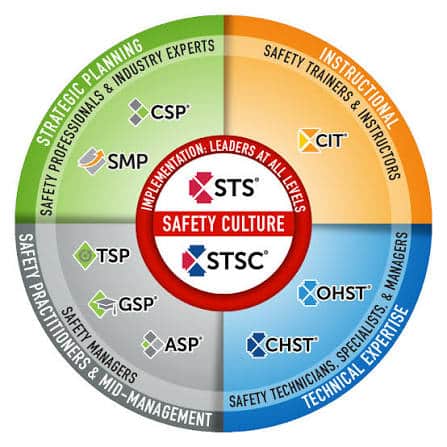
The CSP (Certified Safety Professional) and SMP (Safety Management Professional) sit at the same career level. Full stop. BCSP (Board of Certified Safety Professionals) groups them together under what it calls the strategic-planning tier – safety experts focused on company-wide prevention of harm and loss, working across management systems, risk, emergency preparedness, and the business case for safety.
The difference BCSP itself highlights is straightforward: the CSP is more education-based, requiring a bachelor’s degree, while the SMP is built around 10 years of hands-on experience instead. One credential qualifies you through the educational background; the other qualifies you through a decade of managing safety programs.
That single distinction dismantles the ‘SMP is higher’ and ‘SMP is lower’ debate simultaneously. They’re peers. Treating them as rungs on the same ladder misreads how BCSP actually designed its credential system.
Where SMP vs CSP Fits in BCSP's Full Credential Structure
The clearest proof that these are separate paths – not sequential steps – is who is allowed to apply for each. The trade-offs in the eligibility criteria reveal exactly what each credential is designed to reward.
The CSP asks for a degree, plus a qualifying credential, plus four years of experience. The SMP asks for none of those academic prerequisites – but requires more than double the experience, with that experience concentrated in safety management roles.
The SMP doesn’t lower the bar. It moves the bar from the classroom to the field. A decade of managing safety programs is among the highest experience requirements of any BCSP credential. This is not a shortcut.
Why BCSP Created the Experience Route
BCSP was explicit about the rationale behind the SMP: a bachelor’s degree requirement alone disqualifies plenty of otherwise-qualified safety professionals. Not everyone has had the financial means or life circumstances to pursue a four-year degree. And a degree in occupational safety doesn’t automatically produce a strong practitioner – some of the most effective safety managers built their expertise entirely through years of fieldwork, program leadership, and hard-earned decisions in the field.
The SMP exists to credential those professionals. Know more details.
Is the SMP Exam Easier Than the CSP?
This question comes up constantly, and it deserves a direct answer rather than a diplomatic dodge. Some CSP holders report that the SMP exam felt less demanding. Others – including professionals who hold both credentials – say the opposite: that the SMP was more challenging, because it leans heavily on strategy, management frameworks, and applied judgment rather than recalling technical facts.
One professional who holds both described the CSP as heavier on memorizing core SH&E principles, and the SMP as almost entirely scenario- and judgment-based. So which is accurate?
If your background is technical and academic, the CSP content will feel familiar. The SMP’s management-strategy emphasis may challenge you more than you expect.
If your background is years of running safety programs, the SMP will feel natural. The CSP’s applied-science breadth – toxicology, statistics, chemistry – may be the steeper climb.
‘Easier’ almost always means ‘closer to what I already know.’ It’s not a measure of the credential’s rigor. The exam blueprints explain why – and they’re worth examining in detail.
SMP vs CSP Exam Blueprints: Different Angles on the Same Profession
This is where the structural difference becomes concrete. The blueprints confirm these two credentials test the same profession from different vantage points – not a junior and senior version of one exam.
SMP vs CSP: Where the Blueprints Diverge
Domain weightings from the official SMP2 and CSP11 exam blueprints
Recognition Is Not the Same as Career Value
There’s one practical difference worth stating plainly. The CSP has a 50-year track record. It’s the credential most widely named in job postings, filtered for in HR systems, and referenced in some regulatory definitions. The SMP has been available since 2017 and was renamed from ‘Safety Management Specialist’ in 2025. Some employers and HR teams still don’t fully understand what it is or how it relates to the CSP.
That’s a recognition gap, not a rigor gap. The gap is closing, but it exists. If you’re weighing the two credentials, factor in your market: in certain regions and industries, the CSP name still opens doors faster simply because more hiring managers know what it means.
Name recognition and professional rigor are different things. The SMP’s 10-year experience requirement is demanding by any standard. But career strategy is part of the decision too, and ignoring the recognition factor wouldn’t be honest advice.
📌 Preparing for the ASP or CSP exam? Get a blueprint-aligned course built by a CSP, CFPS, CIH-holder.
How to Choose Between SMP vs CSP for Your Career?
If you meet the eligibility requirements for the CSP, it’s generally the credential we recommend pursuing. The SMP is best viewed as an alternative pathway for experienced professionals who do not meet the CSP’s educational requirements.
The CSP Is Likely Your Path If You:
- Hold a bachelor’s degree and a qualifying BCSP credential such as the ASP (Associate Safety Professional)
- Work in technically demanding roles where applied science, calculations, and quantitative analysis are part of your regular work
- Want the credential most widely recognized by employers as a standard hiring filter across industries and geographies
- Are building toward a broader technical and program-management skill set
The SMP Is Likely Your Path If You:
Have 10 or more years of experience with a strong safety management component – leading programs, managing teams, influencing organizational decisions
Don’t hold a bachelor’s degree, or your day-to-day work is more program leadership than technical analysis
Want a strategic-level credential that reflects what you’ve built in the field rather than what you studied in a classroom
Operate in an environment where leadership and business-case skills are valued as much as technical knowledge
The Bottom Line on SMP vs CSP
The SMP is not a higher-level CSP. It’s also not a lesser one. BCSP places both credentials at the same strategic-planning tier and defines the real difference clearly: education route versus experience route. The blueprints confirm it – the CSP spreads across technical application and applied science, the SMP concentrates on management systems and the business case for safety.
Pick the credential that matches your qualifications. If you’re eligible for the CSP, it’s generally the preferred choice because of its broader recognition in the industry. The SMP serves as an equivalent pathway for experienced professionals who don’t meet the CSP’s bachelor’s degree requirement.
Eligibility requirements, career-level positioning, and blueprint details in this article reflect BCSP’s current published materials (CSP11 and SMP2 blueprints). Confirm current fees and requirements directly at bcsp.org before applying.
Ready to start preparing for your CSP or work toward the ASP as your qualifying credential? Infinite HSE’s ASP/CSP Preparation Course is built around the current BCSP blueprints, covering every domain with the depth you need to pass and the practical context that makes the material stick. Explore the course and see what’s covered.
FAQ
Yes. BCSP places both credentials at the same strategic-planning tier, defined as safety experts focused on company-wide prevention of harm and loss. The difference is the entry route: the CSP is education-based and requires a bachelor’s degree, while the SMP is experience-based and requires 10 years of safety management experience.
No. The SMP has no degree requirement, which is by design. BCSP created the experience route specifically for qualified safety professionals who may not have had the opportunity or means to earn a bachelor’s degree but have built deep expertise through a decade of managing safety programs.
It depends on your background. Professionals with technical and academic backgrounds tend to find the CSP more natural and the SMP’s management-strategy focus more challenging. Those who have spent years running safety programs often find the reverse. ‘Easier’ typically means ‘closer to what I already do’ – the exams are loaded differently on purpose, not ranked by difficulty.
The CSP blueprint includes a dedicated Occupational Health and Applied Science domain (10%) covering toxicology, epidemiology, statistics, chemistry, and physics. The SMP blueprint has no equivalent applied-science domain. Instead, the SMP concentrates weight in Management Systems (21.7%) and Business Case of Safety (13.8%), making it a management-and-strategy exam. Both cover risk management, incident investigation, emergency response, GHS, and ethics.
Yes. You can hold both credentials, they are not mutually exclusive. However, in our opinion, if you already hold the CSP, pursuing the SMP generally offers limited additional value. The SMP is primarily intended for experienced safety professionals who do not meet the bachelor’s degree requirement for the CSP. Since both credentials represent a similar professional level, the CSP is typically the stronger choice for those who are eligible to earn it.
The CSP has a 50-year history and is widely referenced in job postings, HR systems, and some regulatory definitions. The SMP has been available since 2017 and was renamed from ‘Safety Management Specialist’ in 2025. The recognition gap is closing, but professionals should factor in their market when choosing – in some regions and roles, the CSP name still opens doors faster simply because more hiring managers are familiar with it.
Ready to Prepare for the ASP / CSP Exam the Right Way?
Whether you're heading for the CSP through the education route or the ASP as your qualifying credential, Infinite HSE's course is built around the current BCSP blueprints — with the depth to pass and the context that makes it stick.
13 Sections, 200+ Lessons
Aligned to the latest ASP11 & CSP11 blueprints, organized for clarity.
InfiQ AI Tutor Included
Instant explanations and follow-up Q&A on every practice question, in Arabic or English.
Equation Book & Calculator
Interactive equation reference plus a 1-year TI-30XS calculator license.
Realistic Question Bank
Exam-style practice questions plus flashcards for fast recall.
Expert Instructor Support
Learn from a CSP, CFPS, CIH, CIT, PMP holder — with 1-on-1 booking for questions.
1-Year Flexible Access
Study at your own pace, on-demand, from any device.